How AI and Deep Learning Are Predicting Acoustic Performance in Modern Buildings
The Shift Toward Data-Driven Acoustic Design
Acoustic performance has become a critical component of modern building design as urban density increases and expectations for occupant comfort rise. Traditional acoustic prediction methods, while scientifically robust, often rely on simplified assumptions, empirical charts, or post-occupancy measurements. Artificial intelligence (AI) and deep learning are transforming this landscape by enabling predictive, data-driven acoustic modelling that integrates geometry, material behaviour, and human perception earlier in the design process.
Foundations of AI-Based Acoustic Prediction
From Classical Models to Machine Learning
Conventional acoustic prediction methods, such as ray tracing, image source modelling, and Sabine-based reverberation calculations, are grounded in well-established physical principles². However, these approaches can struggle with complex geometries, hybrid material systems, and non-diffuse sound fields. Machine learning models complement classical theory by learning patterns from large datasets of measured and simulated acoustic responses, allowing predictions that adapt to irregular spaces and layered assemblies without explicitly solving every physical interaction.
Deep Learning Architectures in Acoustic Simulation
Deep learning models, particularly convolutional neural networks (CNNs) and graph neural networks (GNNs), are increasingly applied to acoustic prediction tasks. CNNs can analyse spatial representations of rooms or façade systems, while GNNs model relationships between surfaces, materials, and sound paths. These architectures are capable of predicting metrics such as reverberation time (RT60), sound pressure distribution, and speech transmission indices with increasing accuracy when trained on high-quality datasets³.
Training Data: Measurements, Simulations, and Hybrids
The reliability of AI-driven acoustic prediction depends heavily on training data. Datasets often combine laboratory measurements compliant with ISO 354 or ISO 3382 standards, field measurements from occupied buildings, and physics-based simulations. Hybrid datasets allow models to generalise beyond idealised conditions, capturing the variability introduced by installation tolerances, material ageing, and real-world usage patterns.

Predictive Accuracy Across Building Typologies
AI-based acoustic tools have demonstrated strong performance across typologies such as open-plan offices, classrooms, auditoria, and transport hubs. By learning from diverse spatial configurations, models can predict how acoustic panels, interior cladding, and façade systems interact with sound under different occupancy and usage scenarios. This capability supports early-stage decision-making, where design changes are less costly and more impactful.

Integration With Architectural and Material Systems
Integration With Architectural and Material Systems
Deep learning models capture the frequency-dependent behaviour of complex materials such as perforated panels, micro-grooved timber, and composite absorbers. By learning how backing depth, perforation ratios, and substrate stiffness influence octave-band performance, AI enables more reliable prediction of both low- and high-frequency acoustic control⁴.
Geometry, Facades, and Interior Cladding Complexity
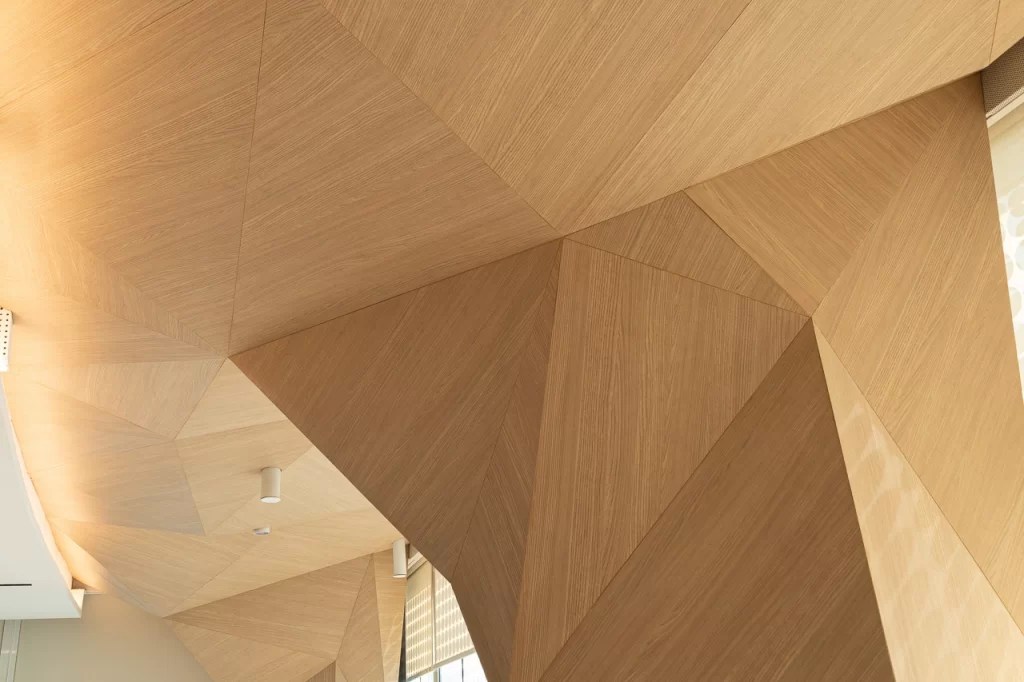
Contemporary buildings increasingly employ free-form geometries and integrated façade and interior cladding systems. AI-driven models process BIM or parametric geometry to predict how curvature and surface articulation affect sound scattering and absorption, supporting balanced acoustic, thermal, and aesthetic performance.
Performance, Compliance, and Certification
Fire-Rating, Low VOC, and Multi-Criteria Optimisation
Acoustic performance must be evaluated alongside fire safety and indoor air quality requirements. AI-driven optimisation frameworks enable designers to assess trade-offs between acoustic metrics, fire-rating classifications, and Low VOC material performance, supporting compliant specification without late-stage substitutions.
Early-Stage Decision-Making and Human-Centric Outcomes
By enabling reliable acoustic prediction during early design phases, AI reduces performance risk and costly retrofits. Emerging models increasingly link physical acoustic metrics with psychoacoustic data, supporting human-centric soundscapes tailored to learning, collaboration, and wellbeing⁶.

The Future of AI-Driven Acoustic Performance
AI and deep learning are redefining how acoustic performance is predicted, specified, and validated in modern buildings. By bridging physical acoustics, material science, and data analytics, these technologies enable more accurate, transparent, and integrated design processes. As datasets expand and models become more interpretable, AI-driven acoustics will increasingly support regulatory compliance, sustainability certification, and occupant wellbeing simultaneously. Rather than replacing established acoustic theory, AI augments it, offering designers and engineers a powerful tool to navigate the growing complexity of contemporary architecture while delivering environments that sound as good as they look.
References
- Cox, T. J., & D’Antonio, P. (2016). Acoustic Absorbers and Diffusers: Theory, Design and Application. CRC Press.
- Everest, F. A., & Pohlmann, K. C. (2014). Master Handbook of Acoustics (6th ed.). McGraw-Hill Professional.
- ISO 3382-1. (2009). Acoustics — Measurement of room acoustic parameters — Performance spaces. International Organization for Standardization.
- ISO 354. (2003). Acoustics — Measurement of sound absorption in a reverberation room. International Organization for Standardization.
- LeCun, Y., Bengio, Y., & Hinton, G. (2015). Deep Learning. Nature, 521, 436–444.
- Thompson, E. (2002). The Soundscape of Modernity: Architectural Acoustics and the Culture of Listening in America, 1900–1933. MIT Press.
Share