Machine Learning Optimized Facade Design for Thermal and Acoustic Efficiency
From Static Envelopes to Intelligent Building Skins
Building façades increasingly function as high-performance environmental regulators rather than passive enclosures. As demands for lower energy use and improved acoustic comfort intensify, traditional rule-based façade design methods struggle to manage the complexity of interacting thermal, acoustic, and geometric variables. Machine learning (ML) introduces adaptive design approaches that analyse large datasets to optimise façade performance dynamically, supporting more responsive and efficient building envelopes.

Machine Learning Foundations in Facade Performance Modelling
Machine Learning Foundations in Facade Performance Modelling
Machine learning models rely on diverse datasets, including climate data, material properties, geometric parameters, and operational patterns. For façade optimisation, features such as solar exposure, wall composition, glazing ratios, and surface articulation are encoded to train predictive models². Proper feature selection is critical, as it determines how effectively algorithms can capture interactions between thermal transfer and sound propagation.
Supervised and Generative Learning Approaches
Supervised learning models are commonly used to predict façade performance outcomes such as heat flux or sound insulation based on known inputs. In contrast, generative and optimisation-driven models explore new façade configurations by iteratively adjusting parameters to meet predefined performance targets. These approaches allow designers to move beyond incremental refinement toward performance-led form generation.
Integration With Simulation and Digital Twins
Machine learning does not replace physics-based simulation but augments it. ML models are often trained on outputs from thermal and acoustic simulations, accelerating iterative testing. When integrated with digital twins, these models support continuous refinement as real operational data becomes available.

Thermal and Acoustic Co-Optimisation Challenges
Optimising façades for both thermal and acoustic performance presents inherent trade-offs. Increased porosity or articulation may enhance sound diffusion while affecting heat transfer, whereas highly insulated assemblies may alter acoustic reflection characteristics. Machine learning frameworks enable multi-objective optimisation, allowing designers to explore balanced solutions rather than prioritising one performance metric in isolation.

Facade Geometry, Materials, and System Behaviour
Geometry-Driven Thermal and Acoustic Response
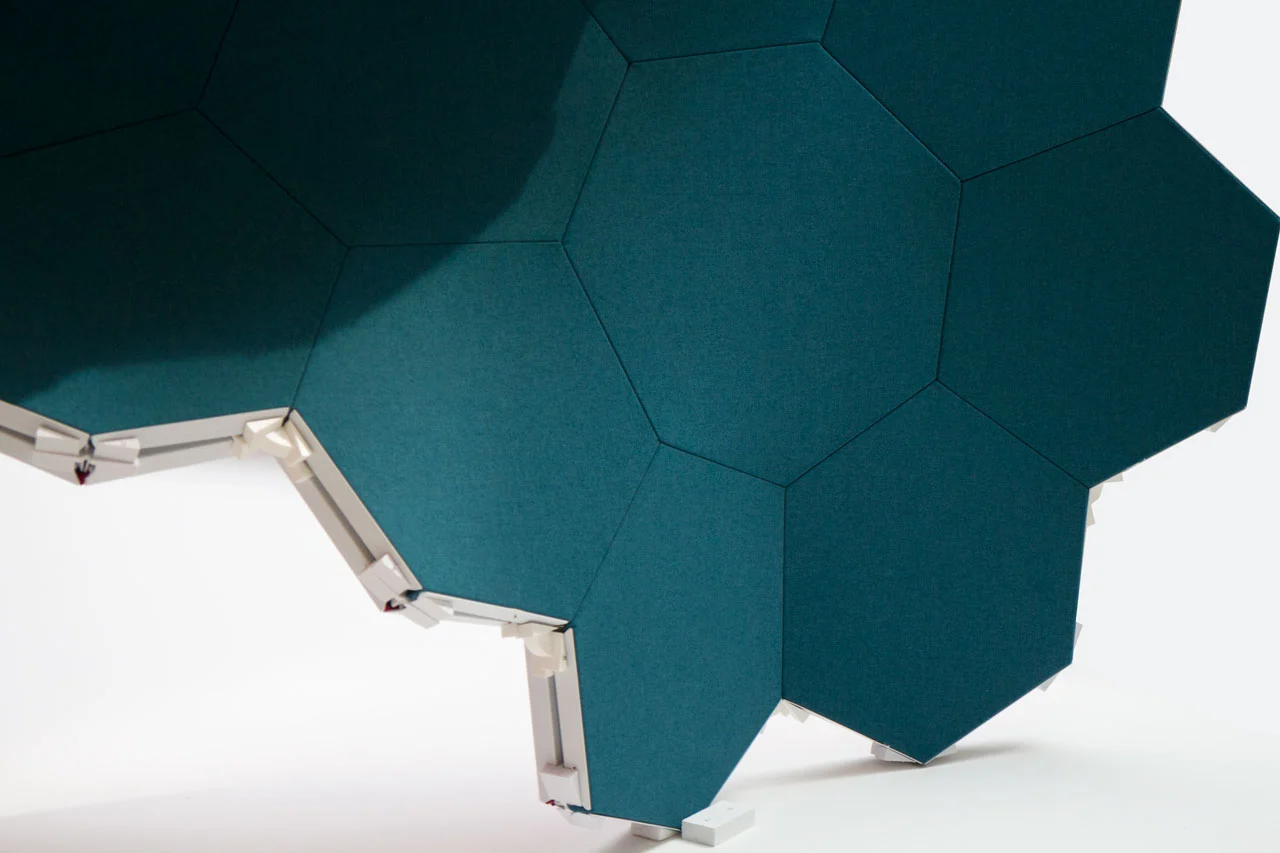
Facade geometry strongly influences solar gain, airflow interaction, and sound scattering. ML models can analyse how curvature, depth modulation, and panel segmentation affect thermal lag and acoustic diffusion across frequency bands. This enables early-stage design decisions that embed performance into form rather than relying on post-design mitigation.
Material Selection and Layer Configuration
Machine learning supports evaluation of layered façade assemblies by correlating material combinations with performance outcomes. By learning from datasets that include insulation types, cladding density, and cavity depth, models can identify configurations that optimise both U-values and airborne sound insulation with fewer iterations.
Implementation, Validation, and Design Practice
Performance Validation and Standards Alignment
ML-optimised façade designs must still be validated against recognised thermal and acoustic standards. Simulation outputs and predictive models are typically benchmarked against ISO and ASHRAE methodologies to ensure regulatory compliance and credibility⁴. This step is essential for translating computational optimisation into buildable solutions.
Workflow Integration and Design Decision Support
Rather than replacing designers, ML tools act as decision-support systems. Integrated into parametric modelling and BIM environments, they provide real-time feedback on performance implications of design changes. This integration improves collaboration between architects, façade engineers, and acoustic consultants.

Toward Adaptive and High-Performance Facades
Machine learning optimised façade design represents a shift toward adaptive, evidence-based building envelopes capable of addressing thermal and acoustic demands simultaneously. By leveraging large datasets and predictive analytics, ML enables designers to navigate complex performance trade-offs with greater confidence and efficiency. As validation frameworks mature and integration with real operational data improves, machine learning is likely to become a foundational tool in delivering façades that are not only expressive and compliant, but also measurably efficient and acoustically comfortable throughout their lifecycle.
References
- International Organization for Standardization. (2017). ISO 52016-1: Energy performance of buildings — Energy needs for heating and cooling, internal temperatures and sensible and latent heat loads. ISO.
- International Organization for Standardization. (2009). ISO 3382-1: Acoustics — Measurement of room acoustic parameters — Performance spaces. ISO.
- Nguyen, A. T., Reiter, S., & Rigo, P. (2014). A review on simulation-based optimisation methods applied to building performance analysis. Applied Energy, 113, 1043–1058.
- World Health Organization. (2018). Environmental Noise Guidelines for the European Region. WHO Regional Office for Europe.
- Zhangabay, N., Tursunkululy, T., Ibraimova, U., & Abdikerova, U. (2024). Energy-Efficient Adaptive Dynamic Building Facades: A Review of Their Energy Efficiency and Operating Loads. Applied Sciences, 14(23), 10979.
- Pomponi, F., & Moncaster, A. (2017). Circular economy for the built environment: A research framework. Journal of Cleaner Production, 143, 710–718.
Share